
Before you can even start apartment hunting in Seoul, you need to understand one thing that trips up almost every foreign renter: Korea doesn’t have a single “rent” system like most countries. Instead, there are two fundamentally different structures — Jeonse and Wolse — and choosing the wrong one can lock up your savings or cost you more than expected.
Here’s a licensed agent’s breakdown of both, and which one actually makes sense for you.
1. The Two Systems at a Glance
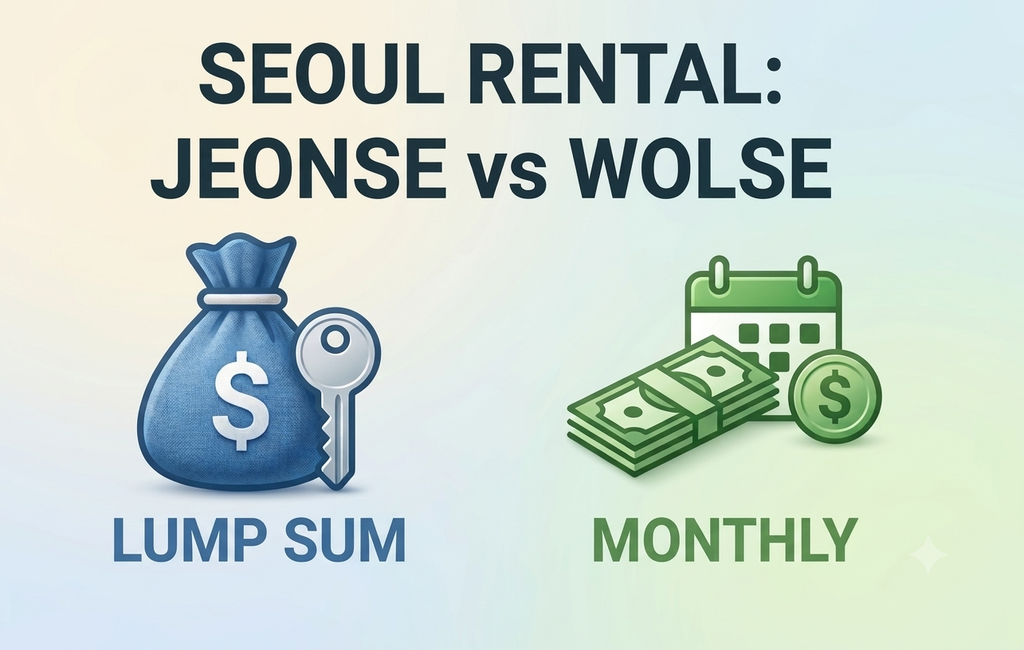
Wolse (월세) works the way most people expect: you pay a smaller upfront deposit, then a fixed monthly rent — closest to what renters abroad already know.
Jeonse (전세) is uniquely Korean: you hand over a large lump-sum deposit — commonly 60% to 80% of the property’s market value — and pay zero monthly rent for the entire lease term. At the end of the lease, you get the full deposit back.
On paper, Jeonse sounds like a great deal. In practice, it’s usually the wrong choice for most expats, for reasons we’ll get into below.
2. Wolse Explained
Under Wolse, you pay a refundable security deposit (typically $7,300 to $37,000+ USD, or 10,000,000 to 50,000,000+ KRW, depending on the unit and district) plus fixed monthly rent.
One useful quirk of the Korean market: landlords will often let you adjust the balance between deposit and monthly rent. Offer a higher upfront deposit, and your monthly rent typically drops based on a statutory conversion rate (전월세 전환율) — useful if you have savings but want to minimize your fixed monthly costs.
Best for: shorter stays (under 2 years), anyone without a large lump sum ready to deploy, and anyone who wants flexibility if their situation changes.
3. Jeonse Explained
Jeonse deposits are enormous by comparison — often the equivalent of buying a used car in cash, except it’s a security deposit, not a purchase. Because there’s no monthly rent, the total cost of living can look cheaper over a long lease. But two things make this risky for foreigners specifically:
- Deposit return risk: your entire deposit rests on the landlord’s financial stability and on you correctly filing your 전입신고 (move-in report) and 확정일자 (fixed date) to secure legal priority. Get this wrong, and recovering your deposit if a landlord goes bankrupt becomes a serious legal battle — one that’s much harder to navigate without fluent Korean and local legal knowledge.
- Capital lock-up: your money is illiquid for the entire lease term, which is a bigger problem if your stay in Korea is uncertain or short-term.
4. Which One Should You Choose?
For the vast majority of expats, digital nomads, and internationally assigned professionals, Wolse is the safer and more practical choice — and it’s what we recommend to nearly every client in this situation. The exceptions are rare: long-term residents (5+ years), those with significant capital who fully understand the legal protections, or those working closely with a trusted local agent who can verify the landlord’s financial standing in detail.
Jeonse isn’t inherently bad — it’s simply a system built around long-term Korean residents with deep local knowledge, not a system designed with short-to-medium-term foreign renters in mind.
5. Quick Decision Checklist
- Staying under 2 years? → Wolse
- No large lump sum available? → Wolse
- Want flexibility to break or adjust your lease? → Wolse
- Staying 5+ years with a trusted local agent verifying the landlord? → Jeonse may be worth exploring
- Not fluent in Korean and unfamiliar with 전입신고/확정일자? → Wolse, no exceptions
Still Deciding?
Every district and building type comes with its own deposit ranges and negotiation norms, and getting the deposit-to-rent conversion right can save you real money. If you’d like a second opinion before signing anything, reach out through our Contact Us page with your target move-in timeframe and budget — happy to walk you through it.