
Every year, foreign renters in Seoul lose their deposits — sometimes their entire savings — to red flags when renting in Seoul that a local agent would have caught in five minutes. Whether you’re going the Wolse or Jeonse route, or renting an officetel or studio, the risks below apply regardless of the lease type.
These red flags aren’t rare — and you can check all of them yourself. But most of these checks require reading Korean-language legal documents accurately, knowing what “normal” looks like in the local market, and sometimes acting within hours — not days — of a listing appearing. That’s precisely the gap a licensed agent is there to close. Here’s what we actually verify before letting a client sign anything, so you know what’s being checked on your behalf.
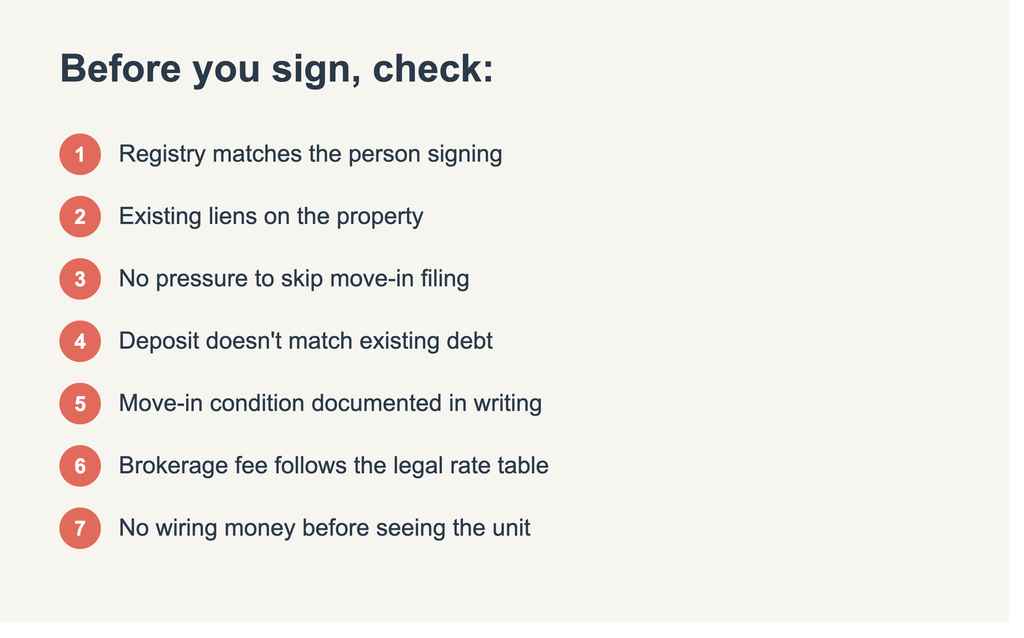
1. The Registry Doesn’t Match the Person You’re Dealing With
Every legitimate transaction starts with pulling the property’s 등기부등본 (certified real estate register), which shows the actual registered owner and any existing liens (근저당).
Red flag: the person signing isn’t the registered owner and can’t produce a proper power of attorney. This is one of the most common scam structures in Korea. A licensed agent checks this as standard procedure on every listing — it’s not an extra step, it’s the first one.
2. Existing Liens That Eat Up the Property’s Value
Even with a legitimate landlord, the amount of existing debt registered against the property matters. If it’s heavily mortgaged, your deposit sits behind the bank’s claim in a bankruptcy scenario.
Evaluating whether a given lien level is “safe” relative to a specific deposit amount isn’t a fixed rule of thumb you can Google — it depends on the property type, district, and current market value, which shifts constantly. Spotting this red flag early is exactly the kind of judgment call an experienced local agent makes routinely and can walk you through line by line.
3. Pressure to Skip 전입신고 and 확정일자
This is the single most important legal protection a renter has in Korea — and the one step scammers most want you to skip. Filing your move-in report (전입신고) and fixed date (확정일자) at your local community center establishes your legal priority to recover your deposit.
Red flag: a landlord who discourages you from filing immediately or claims it’s “not necessary.” A good agent will not only tell you to do this — they’ll make sure you actually do it correctly and on time, since the exact timing can affect your legal standing.
4. A Deposit Amount That’s Oddly Convenient
If a deposit request lines up suspiciously well with existing debt already on the property, be cautious — some landlords use incoming deposits to cover existing loans, leaving little cushion if things go wrong. Spotting this pattern requires comparing the registry against the deal terms side by side, which is standard due diligence for an agent but easy to miss on your own.
5. No Written Record of the Property’s Condition at Move-In
This last red flag is easy to miss: Photograph and document every scratch, stain, and appliance issue on day one, dated and ideally shared with the landlord or agent in writing. Without this, deposit deductions for “damage” become your word against theirs. A good agent will typically walk the unit with you and help formalize this record, so it holds up later.
6. Brokerage Fees That Don’t Follow the Legal Rate Table
Real estate brokerage fees (복비) in Korea aren’t arbitrary — they’re capped by a government-mandated rate table (중개보수 요율표) that varies by transaction type and price band. Because deposit and rent amounts vary so widely, there’s no single “normal” fee figure that applies across the board — a fee that looks high for one unit can be perfectly correct for another once you factor in the deposit size and lease structure.
What matters isn’t the number itself, but whether your agent can clearly explain how it was calculated. Ask your agent to walk you through the rate table calculation for your specific deposit and rent amount — a licensed agent should be able to do this transparently, on request, every time.
7. “Too Good to Be True” Listings
Below-market terms combined with pressure to wire money quickly, before you’ve seen the unit or verified the registry, is a classic pattern — especially targeting renters searching from outside Korea before their move. Never transfer money without seeing the property and verifying ownership documents first. If you’re working with a licensed agent, this step happens before you’re ever asked to send anything.
The Bottom Line
None of this is meant to scare you off renting in Korea — it’s meant to show exactly how much verification goes into a transaction that looks simple on the surface. Most of it isn’t something you should have to learn to do yourself under time pressure, in a language you may not read fluently, while trying to secure housing before a move-in deadline.
This is the actual value a licensed agent brings — not just finding listings, but catching the details above before you’re financially exposed. If you’d like help reviewing a specific listing or contract, reach out via our Contact Us page with the details — happy to take a look.