Key money in Korea is one of the most misunderstood terms for foreign renters, mostly because it sounds like it should be the same thing as a deposit. It isn’t, and mixing the two up can lead to a confusing negotiation or, worse, a payment you didn’t actually owe.
Here’s what key money actually is, who pays it, and how it’s different from the deposits we cover in our Jeonse vs Wolse guide.
Table of Contents
Key Money vs Deposit: The Core Difference
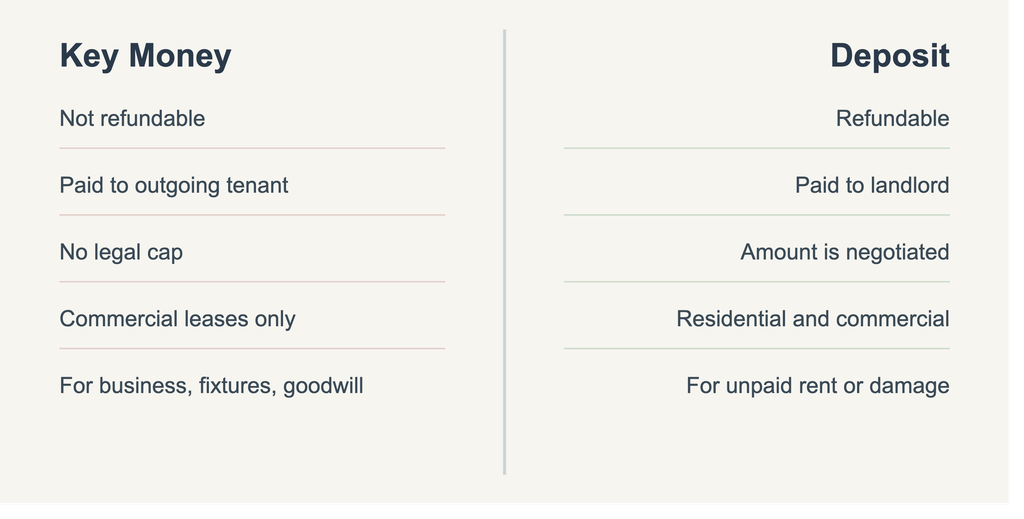
Your security deposit (보증금) is refundable. You get it back at the end of your lease, assuming no damage or unpaid rent. Key money (권리금), by contrast, is a separate payment that has nothing to do with your landlord or your housing deposit at all, it’s tied to commercial leases, not residential ones.
What Key Money Actually Covers
Key money in Korea applies almost exclusively to commercial spaces: a shop, restaurant, or office unit with an existing business inside it. It’s a payment the incoming tenant makes to the outgoing tenant, not the landlord, to take over the existing business’s location, fixtures, customer base, or goodwill. It typically breaks down into a few categories: 시설 권리금 (facility key money, for existing fixtures and renovations), 영업 권리금 (business key money, for the existing customer base and brand recognition), and sometimes 바닥 권리금 (location key money, simply for the value of the spot itself).
1. Residential Renters Almost Never Pay It
If you’re renting an apartment, officetel, or studio for personal residence, key money in Korea generally doesn’t apply to you at all. This is the single biggest source of confusion: renters searching for apartment listings sometimes come across the term in commercial listings and assume it’s a fee they’ll owe too.
2. It’s Negotiated Between Tenants, Not With the Landlord
Because key money changes hands between the outgoing and incoming tenant, the landlord is often not a party to that negotiation at all, though they usually need to approve the new tenant. This is a different relationship than your brokerage fee, which we cover separately in our guide to real estate agent fees in Korea.
3. It’s Not Legally Capped the Way Brokerage Fees Are
Unlike the brokerage fee, which is regulated by a legal rate table, key money in Korea is a private negotiation between two tenants, and the amount can vary enormously based on the location, foot traffic, and how established the existing business is. There’s no government cap to check it against, which makes due diligence on the actual value more important, not less.
4. It Can Disappear If the Business Fails Before Handover
Key money is paid for an ongoing concern. If the outgoing business closes or the space sits empty before you take over, much of what you were paying for, the customer base and goodwill, may no longer exist. This is a real risk in commercial key money negotiations, and it’s worth confirming the current state of the business before any payment changes hands. For background on relevant regulations, the Ministry of SMEs and Startups publishes guidance on commercial lease protections.
The Bottom Line on Key Money in Korea
If you’re a residential renter, the short version is: you almost certainly won’t encounter key money in Korea, and if a listing mentions it, double-check whether you’re actually looking at a commercial space. If you are entering a commercial lease, key money is a separate, unregulated negotiation that deserves its own due diligence, distinct from your deposit and your brokerage fee.
If you’re unsure whether a listing you’re looking at involves key money, or want help sorting residential from commercial terms, reach out through our Contact Us page with the listing details. Happy to clarify before you commit to anything.