Public transportation in Seoul is one of the best parts of living here. The subway reaches almost every neighborhood, buses fill in the gaps, and one card works across both. But fares, transfer rules, and the city’s unlimited pass have details that catch newcomers out, and small mistakes can quietly double what you pay.
Here’s how the system works as of 2026, and the five mistakes to avoid. Since your commute shapes where you should live, it’s worth reading this before choosing a neighborhood, too.
Table of Contents
How Public Transportation in Seoul Works
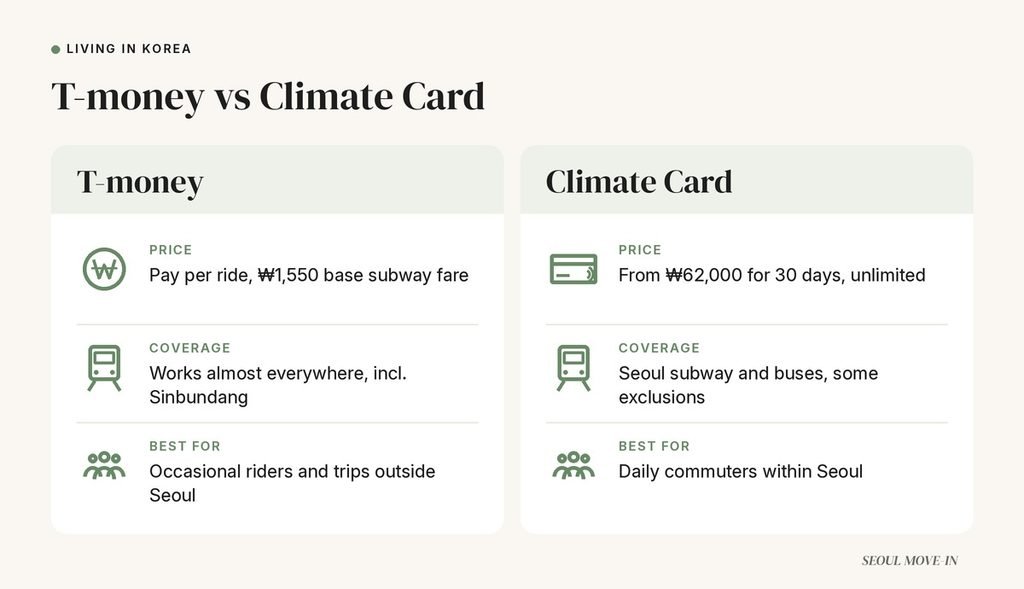
Most residents pay with a rechargeable transit card. A T-money card can be bought at convenience stores such as GS25, CU, 7-Eleven, and emart24, or at subway station machines, and topped up at the same places. As of 2026, the basic adult subway fare with a transit card is 1,550 won for trips up to 10 km, with extra charges for longer distances. You can find card and fare details on the official T-money website.
If you ride every day, Seoul also offers the Climate Card, an unlimited monthly pass. As of 2026, a 30-day pass costs 62,000 won for the subway and buses, or 65,000 won with the Ttareungyi public bike, plus a one-time card fee. Short-term passes of one to seven days are also available for visitors.
1. Using Single-Journey Tickets
Paper single-journey tickets cost more than a card fare, require a refundable deposit, and don’t qualify for transfer discounts. If you’ll be riding more than a couple of times, get a transit card on your first day.
2. Forgetting to Tap Out
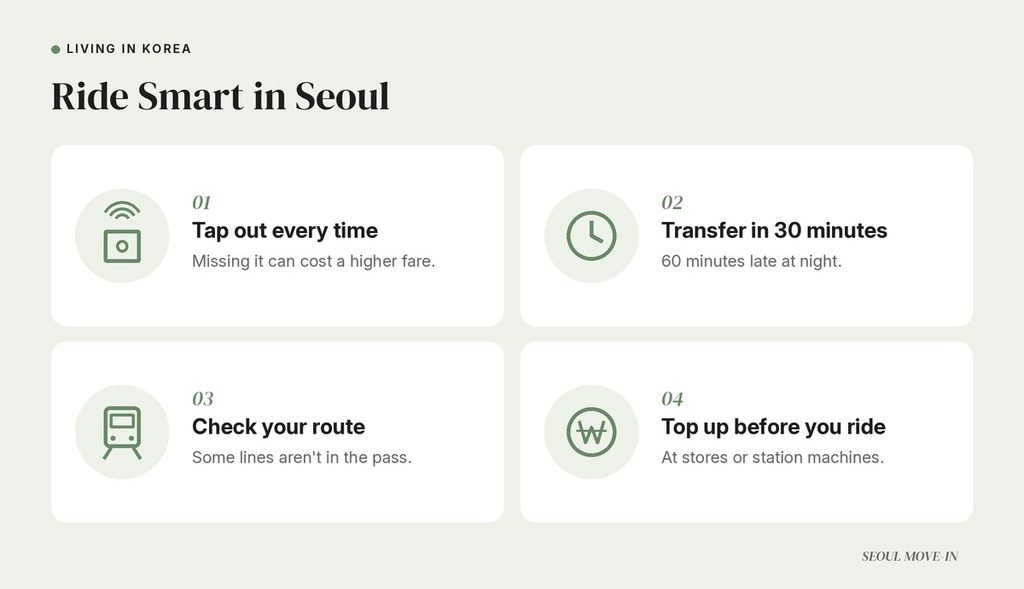
On the subway, you tap in and out at the gates. On buses, you also need to tap the reader when you get off. If you forget, you can lose your transfer discount and may be charged the maximum distance fare. It’s one of the most common and most avoidable extra costs for newcomers using public transportation in Seoul.
3. Missing the Transfer Window
Transfers between subway and bus are discounted when you board the next ride within 30 minutes of tapping out, or within 60 minutes for trips that begin late at night between 9 p.m. and 7 a.m. Stop for a long coffee between rides, and the next one counts as a new trip.
4. Buying the Climate Card Without Checking Your Route
The Climate Card covers most subway and bus routes in Seoul, but not everything. As of 2026, the Sinbundang Line, some long-distance buses to and from the suburbs, and the Incheon Airport section of the Airport Railroad are excluded. If your commute crosses into Gyeonggi-do or uses one of these lines, a regular T-money card may work out cheaper.
5. Choosing a Home Without Mapping the Commute
Two apartments with the same rent can mean very different daily lives depending on the subway line. Before signing, test the route from the nearest station to your workplace at rush hour, and check how many transfers it takes. Our neighborhood guides, such as Mapo vs Seongsu and Jamsil vs Gangdong, compare the subway lines in each area.
The Bottom Line on Public Transportation in Seoul
Public transportation in Seoul is fast, affordable, and easy once you know the rules. Get a transit card on day one, tap out every time, transfer within the time window, and check whether the Climate Card covers your daily route before buying it. Fares and pass prices change from time to time, so confirm the latest figures before you rely on them.
Where you live decides how you’ll ride. If you’re looking for a home near the right subway line, reach out through our Contact Us page with your workplace, budget, and move-in date. We’ll shortlist homes that keep your commute simple, using the steps in How to Find an Apartment in Seoul. Planning around your office first? See Seoul Business Districts.